Running a Video Technique Review Program at Your Swim Club
By the Swimo.fit team · August 30, 2026
Video review is the highest-leverage coaching tool a club can add with hardware it already owns. This guide covers the capture habits, the feedback craft, and the safeguarding design that make a program work.
Why video works where shouted cues don't
Most swimmers cannot feel the fault you can see. A crossing hand entry or a dropped elbow feels normal from inside the stroke, and a cue shouted across six lanes of splashing reaches the swimmer stripped of context. Thirty seconds of footage ends the argument: the swimmer sees what you see, and the correction stops being an opinion.
The clubs that get value from video are not the ones with the best cameras. They are the ones with a routine: capture regularly, review promptly, and keep the feedback where swimmer, parents, and coaches can all find it later.
Capture habits that make footage useful
The difference between usable and useless footage is almost entirely habits, not hardware. A phone or tablet from the deck is plenty if you:
- Keep clips short: under a couple of minutes, ideally one length with one focus. Long clips bury the moment you wanted.
- Decide the focus before pressing record: 'left arm on breath strokes', not 'freestyle'.
- Shoot from the side at water level for stroke mechanics, head-on for breathing and symmetry, and behind the block for starts.
- Hold still. Panning with the swimmer feels natural and ruins frame-by-frame review.
- Tag who it is and what it shows at capture time, because footage nobody can attribute a week later is footage nobody reviews.
Feedback that actually changes the stroke
Written feedback outlives anything said on deck. The swimmer rereads it before the next session, the parent understands what the club is working on, and the next coach inherits the history instead of starting over. What makes it land:
- One correction at a time, because a critique with five faults fixes zero of them
- Point at the moment: 'watch the left hand as you breathe' beats a paragraph of theory
- Pair every fault with the drill that addresses it and when you'll rep it
- End with something genuinely good, because swimmers rewatch praised clips
- Review within a few days while the session is still in the swimmer's body
The safeguarding section most guides skip
A technique program means adults recording children and exchanging messages about the footage. That deserves the same deliberate design as anything else involving minors:
- Consent first: the club should hold recording consent for every swimmer before the first clip, and respect a no without making it awkward
- Club devices and club accounts: technique footage of children does not belong in a coach's personal camera roll
- No private channels: feedback about a child should be visible to their parents by design, not by promise. If your tooling allows an adult to message a child privately, that is a policy problem no policy document fixes.
- Purpose limitation: footage is for coaching, and using it anywhere else, including club marketing, is a separate consent conversation
The worked example: technique review in Swimo.fit
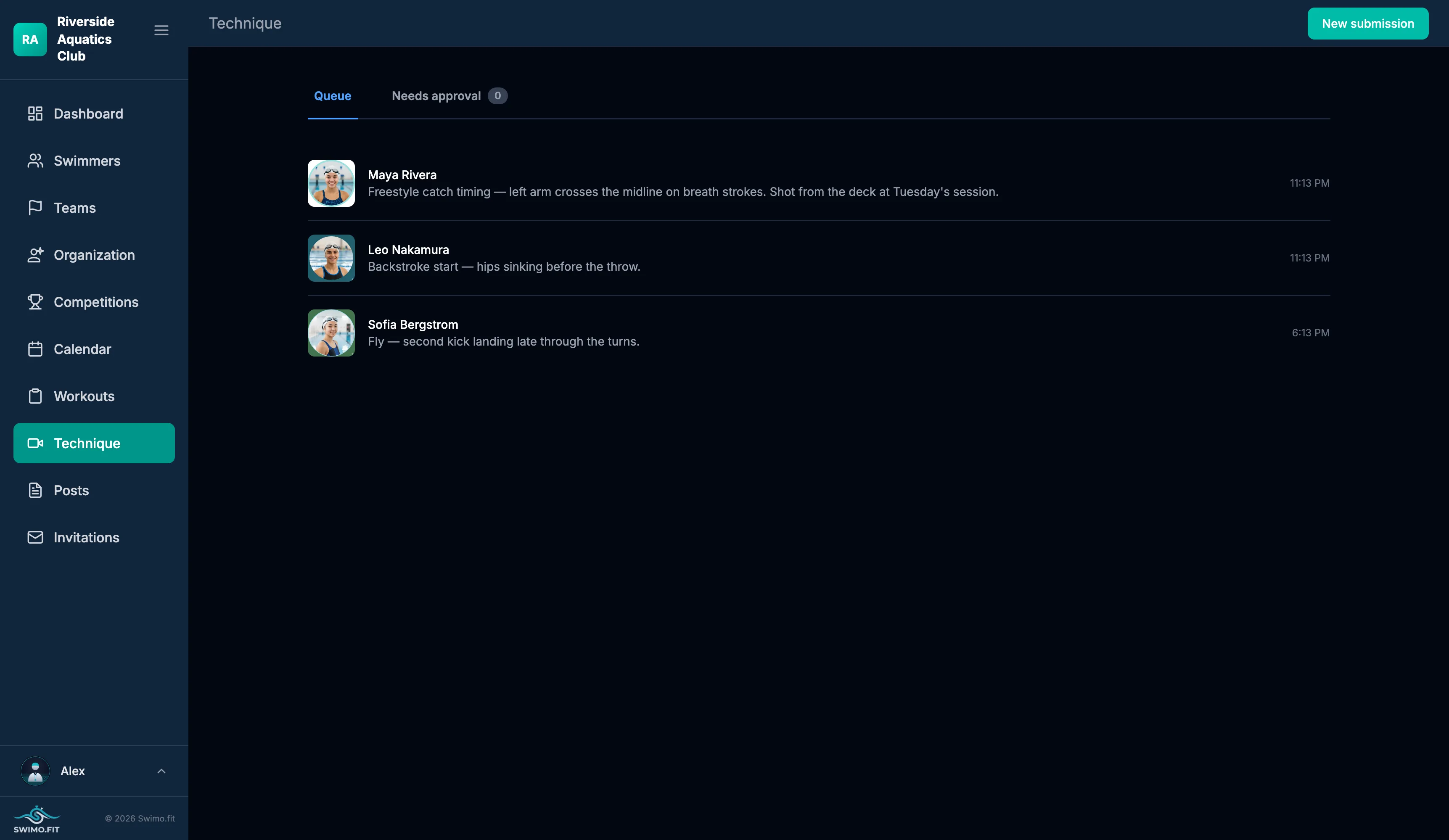
Swimo.fit's technique review is built around exactly these habits. Coaches record and tag poolside in the app and clips upload in the background; critiques are written on the web with their history kept; and who sees a submission is derived from the swimmer every time: assigned coaches, linked parents, and the swimmer. There is no private channel between an adult and a child on Swimo.fit, structurally: the recipient list is not a setting anyone can change.
Clubs that require it can hold an assistant coach's feedback for head-coach approval before the family sees it.