Planning a Season of Swim Workouts for an Age-Group Club
By the Swimo.fit team · August 30, 2026
You do not need a sports-science degree to plan a good club season. You need the championship date, three phases, a weekly rhythm, and sessions you can reuse. Here is the practical version.
Start from the meet that matters
Season planning for a club is simpler than the periodization literature makes it sound. Put the championship meet on the calendar, walk backwards, and three phases fall out on their own: a long block of building work, a shorter block of quality and race-pace work, and a brief taper into the meet.
For age-group swimmers the proportions matter more than the vocabulary. Most of the season is building (aerobic capacity, technique, kick) because that is what developing bodies adapt to best. The sharpening block is where race pace, starts, and turns take over. The taper is short: young swimmers need days of freshening, not the weeks a college sprinter might.
A weekly skeleton beats a daily masterpiece
Clubs run on rhythm. A repeating weekly shape, say a technique-focused day, an aerobic day, a kick and skills day, and a quality day, does more for a season than any individual brilliant workout, because swimmers, parents, and assistant coaches all know what a Tuesday is for.
Two realities to design around:
- Attendance is variable. School terms, exams, and family life mean the plan must survive swimmers hitting two sessions one week and five the next, which is why the weekly shape repeats instead of building strictly day on day.
- Groups differ. The same skeleton can hold different volumes: the senior group's aerobic day and the 10-and-unders' aerobic day share a purpose, not a distance.
Write sessions once, reuse them all season
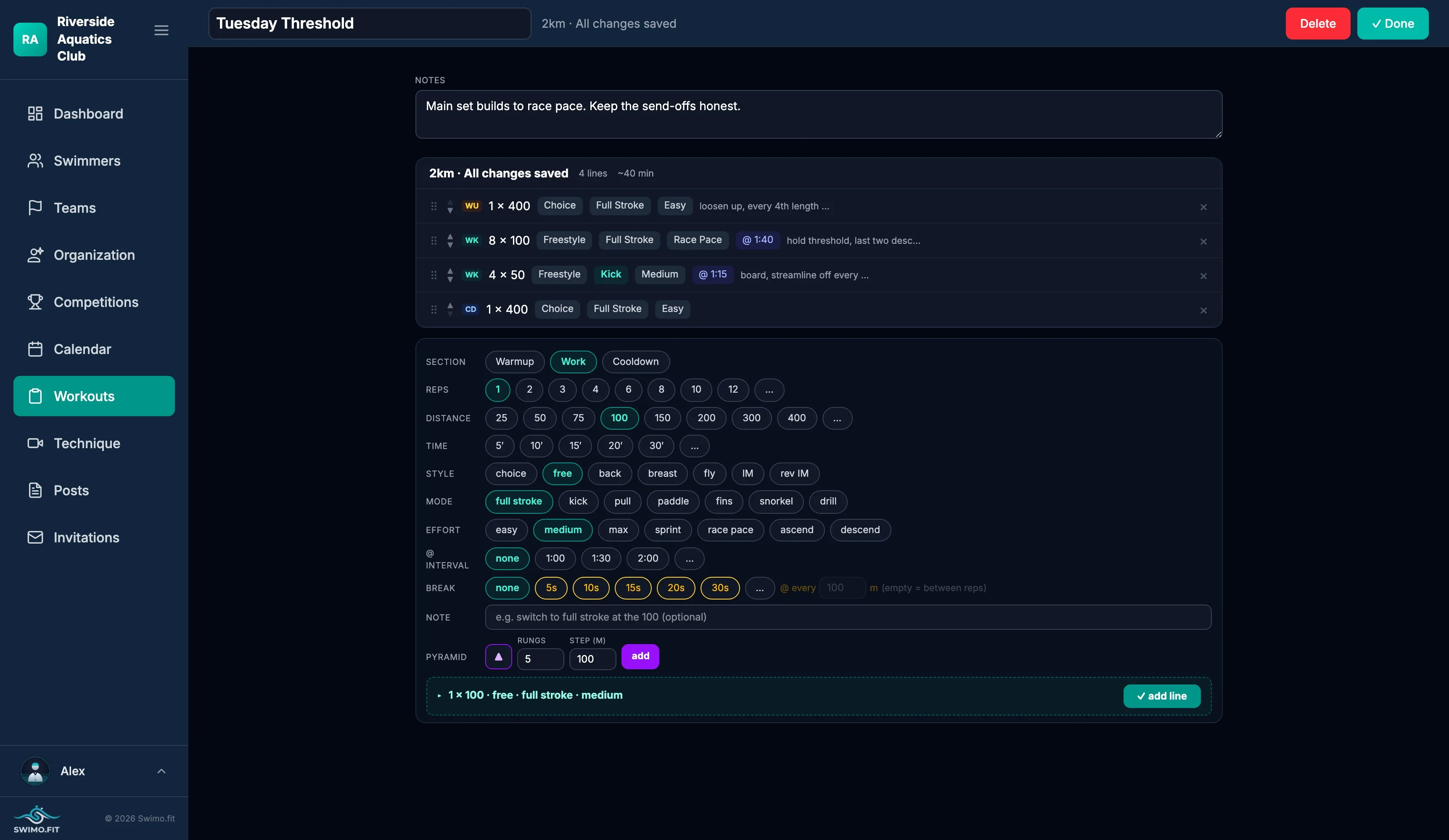
The fastest planning improvement most clubs can make is a library. A good session is an asset: a warmup that actually warms up, a threshold set that fits your pool time, a starts-and-turns circuit. Write it properly once, with strokes, efforts, reps, and send-offs, and reuse it every time that slot in the skeleton comes around.
A written set does something a whiteboard photo never will: the next assistant coach can run it exactly as intended, and the club's training knowledge stops living in one coach's head.
The plan is half; the record is the other half
At season's end, the question is never 'was the plan good?'. It is 'did the swimmers who improved actually do the plan?'. That answer lives in attendance. A session plan attached to a calendar slot, with a record of who was in the water, turns end-of-season review from vibes into evidence: this group got their aerobic block, that swimmer missed the whole sharpening phase, which explains both results.
The worked example: workouts in Swimo.fit
Swimo.fit's workout builder writes sessions the way this guide describes them: structured lines with stroke, mode, effort, reps, distance, and send-off, with totals computed as you build. Sessions save to the club library, attach to calendar sessions, and run from a tablet on deck, with attendance recorded on the session itself, so the plan and the proof live together.